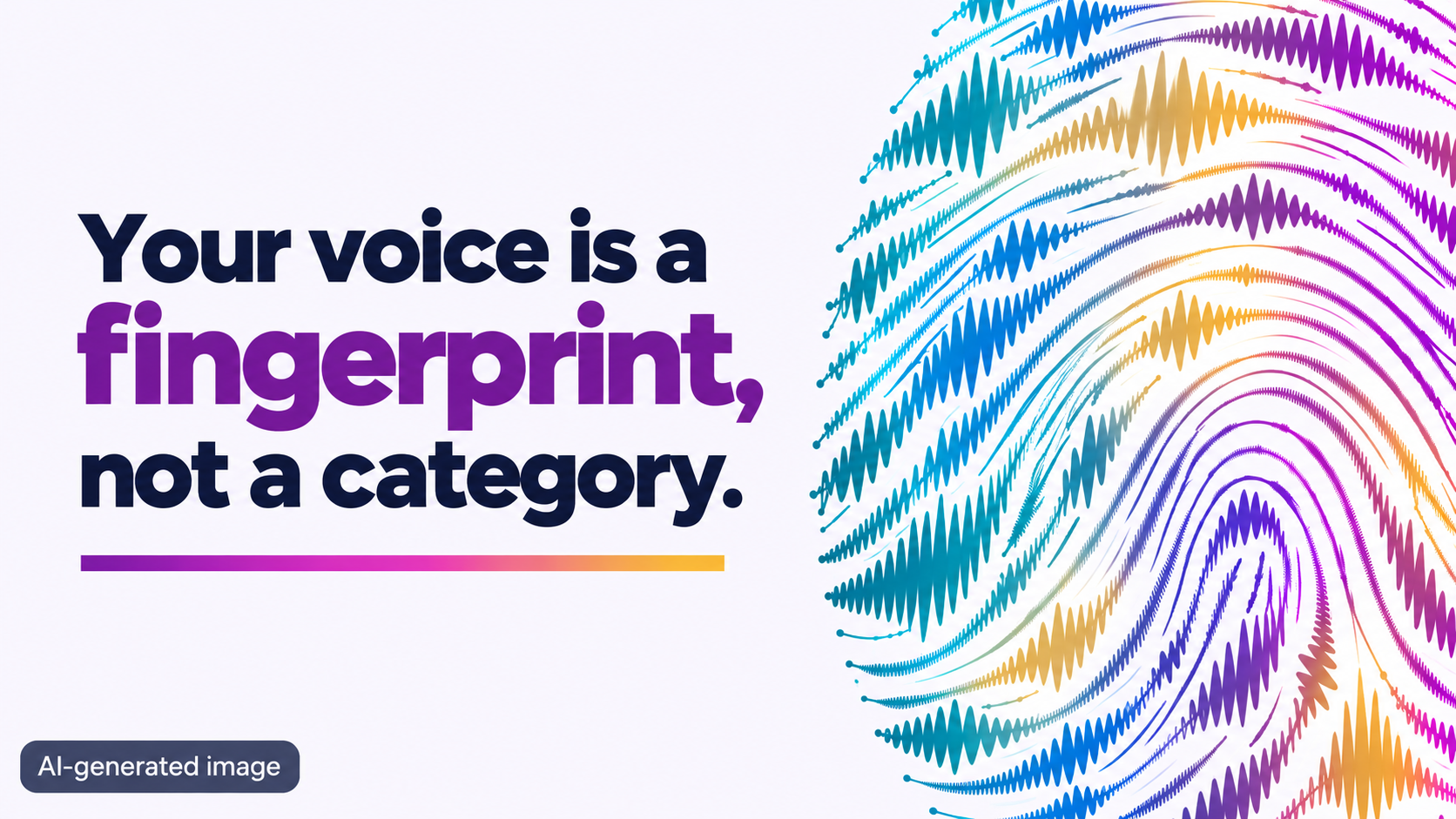
Your Voice Is a Fingerprint, Not a Category
THE SOUL OF IT
Words like warm, authentic and conversational describe a category that fits thousands of people, so AI hands you the average. A fingerprint is specific: what you always say, what you never say, and how you build to a point. Capture it in a one-page Voice DNA document before you scale anything.
Here's a question almost nobody can answer.
You know when something sounds like you. You can feel it in the first sentence. You know just as fast when it doesn't.
But can you say exactly why?
Not "I'm warm." Not "I'm conversational and direct." I mean the specific moves you make when you're at your best. What you always say. What you'd never say. The rhythm of a sentence when you're building to a point.
Most experts can't answer that. Not because they lack a voice. Because they've never had to write it down. And that gap is exactly where AI goes wrong.
Categories are useless to AI
"Warm, authentic, conversational." Those words feel meaningful until you hand them to an AI tool. Then you get content that's warm, authentic and conversational in exactly the same way as every other warm, authentic, conversational person in your field.
That's because those words describe a category, not a fingerprint.
A category sounds like this: "I'm conversational and direct. I care about my audience. I keep it real."
A fingerprint sounds like this: "No business jargon. A short sentence after a long one, to let it breathe. Always the why before the how. Never the word 'journey' without irony."
The first could describe ten thousand people. The second describes one.
AI can work with a fingerprint. It can't work with a category. Give it a category and it falls back on the internet's average voice. Give it a fingerprint and it finally has a specification.
Order matters
I watched a creator learn this the hard way. She built the whole machine first: a small team, a stack of AI tools, a full content calendar. Six months later she was publishing thirty pieces a month, consistent as clockwork.
Her engagement had dropped forty percent.
The system worked. The voice was gone. She had to take months of work apart to go back and do the one thing that should have come first.
Capture your voice before you scale it. Skip that step and everything downstream is slightly off, every single time.
The five parts of Voice DNA
A useful Voice DNA document has five parts. You don't need perfect answers, just accurate ones.
Tone markers. Three to five words for how your content actually feels, not how you wish it felt.
Language patterns. How you open, how you land a point, the transitions you use without thinking. Often invisible to you, obvious to your audience.
Content boundaries. What you won't say, even if it would perform. Without these, AI drifts toward what gets clicks instead of what protects the relationship.
Audience language. The exact words your clients use to describe their problem, from DMs, reviews and discovery calls. Theirs, not yours.
Signature phrases. Your coined terms, frameworks and the analogies you keep coming back to. When AI gets these right, the result sounds unmistakably like you.
One page is the target. Two is the ceiling. This is a working document, not a brand guide.
Why it's worth the effort
Think of your voice as a trust account. Every piece that sounds unmistakably like you is a deposit. Every caption your own audience couldn't identify as yours is a withdrawal.
Voice DNA makes sure everything that runs through your AI tools is a deposit.
Your next step
Start with the free Voice DNA Starter Kit. It takes about 15 minutes and works with any AI tool.
Get the free Voice DNA Starter Kit
Then join me at my next free live Still You Blueprint Masterclass, where I'll show you how Voice DNA powers the whole content system.
Your voice is already worth amplifying. Let's make sure AI can find it.
Rena McGill


